
In uncertain times, a robust PPM platform is critical
A lot of my conversations are feeling like Groundhog Day right now. Every business leader I speak to, the mood is the same: wait and see.
Hold off on the new initiatives, pause any projects that aren’t urgent, and don’t commit to anything big until the picture becomes clearer. And I understand the instinct. It feels responsible. But I’ve watched enough of these cycles to know it’s often the most dangerous call a leadership team can make.
The reality is that in uncertain times, portfolio and project management becomes more critical, not less. The organisations that come through periods of volatility and uncertainty well don’t ‘wing it’, and they definitely don’t freeze either. They invest in the visibility that lets them keep making decisions with confidence while their competitors are stuck in ‘wait and see’ mode.
I think this stems from the outdated view that PPM is ‘just’ an administrative burden or a reporting overhead. The reality though is that in uncertain times it becomes your primary decision-making capability. It’s the thing that keeps strategy moving when so many other things feel like they’re up in the air.
Perhaps you feel differently, but let me show you what it looks like in practice.
What the portfolio view revealed
Several years ago, I worked with the PMO of a prominent oil and gas company. One of its major IT projects had been running for approximately two and a half years. Initially approved with a budget of $1 million, the project had already grown to $2.5 million by the time we implemented a PPM solution.
As portfolio information became more transparent, the true extent of the project’s challenges began to emerge. Risk exposure was high, unresolved issues were accumulating, and significant technical uncertainties and vendor cost dependencies remained. Based on the latest forecasts, the total project cost was expected to double again to approximately $5 million.
For the first time, the executive team had a holistic view of the project within the context of the broader portfolio. This allowed them to move beyond discussing the project in isolation and instead consider where limited funding, resources and executive attention would create the greatest strategic value.
Although $2.5 million had already been invested, the organisation’s other planned initiatives offered substantially greater strategic value and were more critical to achieving its objectives for the financial year. Armed with this collective insight, the executive team made the difficult but informed decision to permanently close the project rather than commit a further $2.5 million to an increasingly uncertain outcome.
It was a powerful example of how effective portfolio management can help organisations move beyond sunk-cost thinking and make decisions based on future value, strategic alignment and the best use of constrained resources.
Uncertainty raises the stakes for every decision
People often imagine ‘uncertainty’ as a single shock that you ride out and recover from. Unfortunately, it’s a lot messier than that. There are three pressures that hit, almost without fail, in these times: budgets are compressed, strategic priorities shift, and resources become scarce. They don’t queue up politely for you to handle one at a time. They all land together.
The counter-intuitive part is what this does to decision-making. Uncertainty doesn’t give you fewer decisions. It gives you more, and fundamentally it strips away the reliable data you’d normally lean on. Every assumption in last year’s plan is suddenly worth re-testing. Every commitment is back up for review. The volume and the stakes both climb at exactly the moment your evidence feels least trustworthy.
But that’s what makes waiting so risky. Inaction isn’t actually a neutral holding position. It’s a decision, and usually a costly one. While you wait, underperforming projects keep drawing budget, your best initiatives stay under-resourced, competitive position quietly erodes, and your teams sit in limbo not knowing whether to push forward or pull back.
Choosing ‘not to decide’ is still choosing, and it’s rarely a strong choice.
Most organisations can’t see clearly when it matters most
So am I telling you to just make faster decisions?
No.
If the fix was simply to decide faster, this would be easy. It isn’t. Because most organisations can’t actually ‘see’ their portfolio. What passes as visibility is more just a patchwork of spreadsheets, email chains, disconnected project tools and siloed business units.
In normal times it might be workable, though still wildly inefficient. But when uncertainty hits, you start to see that your ‘visibility’ is about as clear as mud, because the picture you’re deciding from is fragmented, out of date, or both.
When the portfolio is lacking visibility, you can no longer answer:
- Whether projects that look healthy on paper are actually on track to deliver their intended outcomes and benefits.
- Whether investment is still aligned to strategy, or whether money is going to work that no longer supports the direction of the business.
- Whether there’s capacity to take on something new, based on today’s commitments rather than last quarter’s report.
- Whether a project should be accelerated, paused, re-scoped or stopped to keep the portfolio aligned.
The trap I see leaders fall into is creating more isolated reports or project updates. None of this gets to the heart of the issue though. The thing that starts to make a meaningful difference is when they finally have one trusted view of how their organisation is actually performing, and a clear line from investment to strategic outcome, giving focus to the things that need attention and support.
Without that, I’ve seen how confidence in decision-making erodes fast. Leaders get reactive, chasing whoever raises the loudest concern. They get slow, waiting weeks for someone to consolidate fragmented information into a deck. Or decisions become political, with resources following influence instead of evidence. None of those get you through uncertainty.
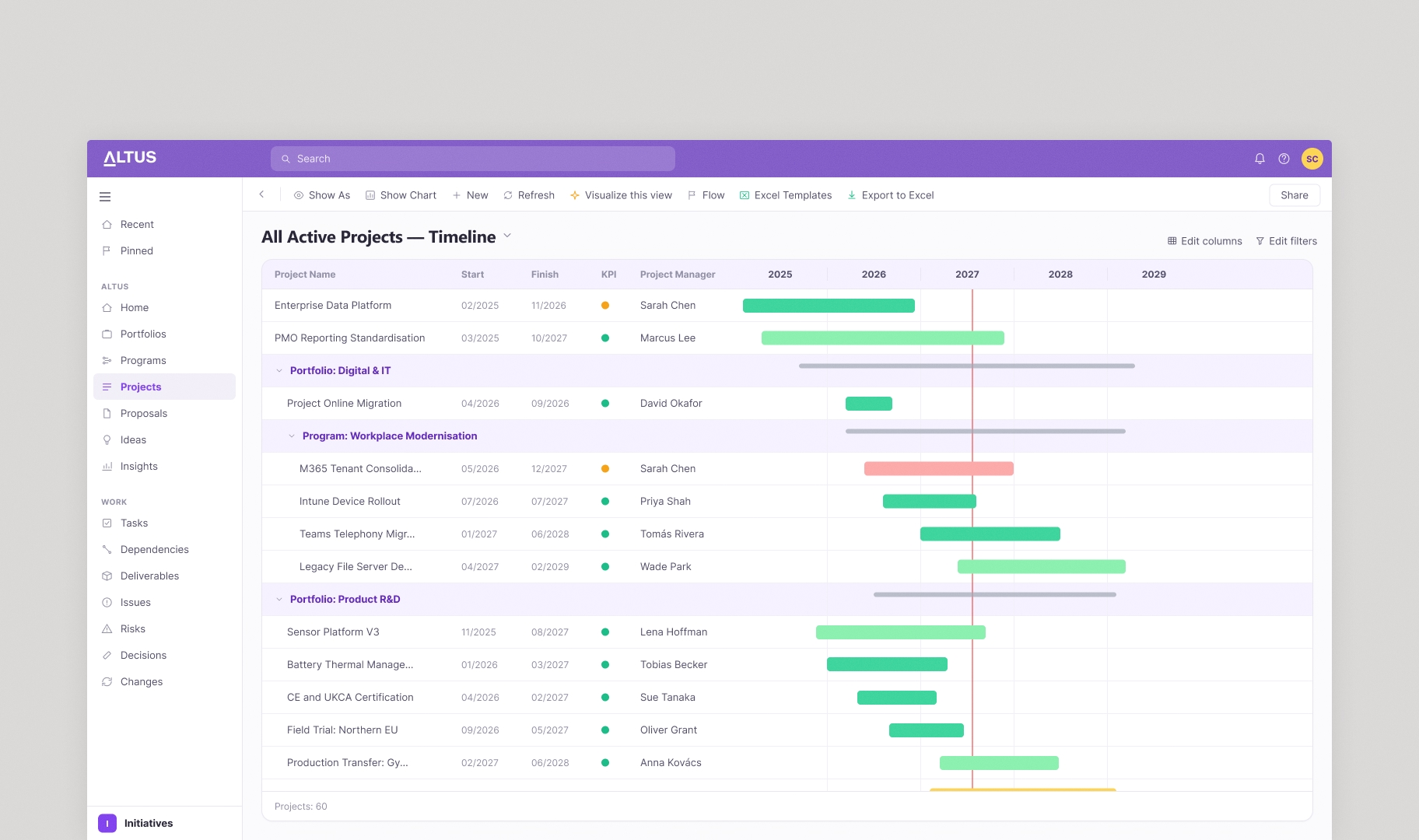
We need to shift the role of PPM from ‘reporting function’ to ‘decision engine’
So much of this stems from an outdated idea of what PPM is for. The traditional view of PPM is simply a governance and reporting tool: status reports, RAG ratings, steering committee decks, a monthly look in the rear-view mirror. Useful work, yes, but to steal a line from Marc Soester, “they’re walking into the future, facing backwards”.
It only tells you what already happened.
For all the technological advances of the last few decades, the connected systems, the benefits of ‘the cloud’, a modern PPM system can, and should, answer a different question. Not just “what happened last month?”, but “what should we do next?” and “what’s the likely impact of each option in front of us?” The output of the system has to change: not project status reports, but portfolio intelligence, live data that connects project activity to strategic outcomes and financial performance.
The principle teams need to remember is this: in uncertain times, the quality of a decision matters more than the speed at which it is made. What matters most is continuing to move in the right direction. Frequent, informed decisions allow organisations to continually course-correct portfolio performance and maintain alignment with company strategy. The objective is not to predict the future perfectly, but to regularly assess what has changed, consider the available evidence and adjust direction when necessary.
I had a conversation with my son earlier in the year, who had completed Year 12 and was uncertain about what he should do next to best support his future. It’s a daunting time for a young adult to be thrust into the world, being told to make critical future decisions for themselves at such a young age (some of us older folks are still trying to figure this out!). My advice was to first identify the direction that felt most appropriate based on what genuinely interested and inspired him, and then continue taking deliberate steps towards it. It’s OK to not have all the answers and everything figured out right now, but keep taking deliberate steps in the right direction.
I also reminded him that it was perfectly acceptable to change direction along the way. As he gained experience, learned more about himself and better understood the opportunities available to him, he would naturally adjust his course. Those adjustments would not mean that his earlier decisions were wrong; they would simply reflect new knowledge. By continuing to move deliberately and correcting course as he learned, he would eventually arrive exactly where he needed to be.
The same principle applies in business. An organisation’s direction is established through its vision and strategy. However, as it navigates an uncertain future, it must continue making informed decisions and adjusting its course in response to changing circumstances, emerging risks and new opportunities.
It is acceptable, and often necessary, for that direction to evolve as the organisation learns more about its environment. This is precisely why company visions, goals and strategies are periodically reviewed and refined. The destination may become clearer, and the route may change, but the important thing is to remain purposeful, informed and aligned with the direction the organisation believes will create the greatest value.
Your tooling is a priority, not an afterthought
This is where tools stop being a nice-to-have and start deciding whether you can decide well at all. Put the two worlds side by side and the gap is obvious.
Technology on its own doesn’t improve decision-making. But the right platform surfaces the right information and makes better decisions possible. When leaders can trust the information in front of them, they spend less time gathering data and more time making informed decisions. The best platforms don’t just manage projects, they connect strategy, investment, delivery, resourcing and benefits into one view, and they build on the technology you already run rather than bolting on another disconnected system.
Financial control is usually where this bites first
A requirement I can confidently say is consistent across almost every client is the need for greater financial control. Unsurprisingly, financial management is almost always among the top five reasons organisations invest in a PPM system.
The first priority is to establish a reliable, near real-time view of the current financial position of the entire portfolio. This requires a time-phased view of project budgets, forecasts and actual expenditure, with the information rolling up across programmes, business units and the broader portfolio. Variances should be immediately visible so that leaders can identify where projects are exceeding budget, forecasts are deteriorating or expenditure is not progressing as expected.
That is a powerful capability for any organisation to have at its fingertips.
Many organisations take this a step further by integrating their finance or enterprise resource planning system with their PPM platform. This reduces manual reconciliation and provides a more complete and dependable view of portfolio financial performance.
Once this centralised view is available, leaders are better equipped to ask the right questions and make informed decisions, including whether to:
- Approve or decline requests for additional project funding.
- Reallocate funding from lower-value initiatives to higher-priority work.
- Reduce project scope to bring forecast costs back within approved limits.
- Release unused budget or contingency for use elsewhere in the portfolio.
- Pause investment until the project’s scope, forecast or delivery approach is reviewed.
- Restructure a project that is no longer financially viable in its current form.
- Accelerate strategically important projects that are performing within budget.
- Defer lower-priority initiatives to protect the organisation’s overall funding position.
- Adjust portfolio priorities in response to emerging financial constraints.
- Renegotiate vendor commitments or revise the project sourcing approach.
- Establish additional financial controls or approval gates for high-risk projects.
- Continue funding a project where the expected value still justifies the increased cost.
- Stop further investment where the remaining cost outweighs the expected benefit.
- Permanently close projects that no longer represent an appropriate use of organisational funding.
The value of this information is not simply that it explains where the money has been spent. Its real value is that it enables leaders to determine where the organisation should invest next, where intervention is required and whether continued investment remains justified.
What this looks like when a real decision hits
A sudden budget cut
The CFO announces a fifteen per cent reduction to the portfolio budget, effective this quarter. Without the tooling, leadership runs a three-week manual review across every team and cuts based on an incomplete picture and whoever pushed hardest. With it, the portfolio manager runs the scenario, filters by strategic value and return, and puts three costed options and their modelled impact in front of leadership. The call gets made in a week, with confidence.
A new strategic priority
A market opportunity opens and the CEO wants something in market inside ninety days. Without tooling, the team scrambles for capacity, creates conflicts across live projects, and can’t say clearly what will slip. With it, the resource impact is modelled straight away, it’s clear which projects can absorb the change and which can’t, and the trade-off is on the table before anyone commits.
A critical project starts to fail
A major transformation programme reports serious delays, overruns and rising delivery risk. Without tooling, leadership gets conflicting reports and can’t tell whether it’s isolated or symptomatic, so decisions stall while people gather information by hand and the risk compounds. With it, the project’s impact on strategy, dependencies, budget and resourcing is immediately clear, recovery options can be modelled, and leadership can decide whether to intervene, re-scope, invest more or stop, before more value is lost.
Conditions change overnight
A competitor launches a disruptive AI-enabled service and customer expectations shift across the industry. Without tooling, leadership wants to respond but can’t see which initiatives can be delayed, where capacity sits, or what commitments will be hit. With it, they model several investment scenarios, understand the strategic impact, rebalance funding and resources, and redirect towards the opportunity with confidence.
An unforeseen resource gap
Two key technical leads resign in the same month. Without tooling, projects slide quietly, PMs absorb the gap locally, and leadership only finds out when dates start slipping. With it, the capacity gap is visible across the portfolio immediately, so reallocation, scope adjustment or external resourcing happens before delivery is compromised.
From wait-and-see to acting with confidence
The instinct to wait is understandable. Every leadership team wants more certainty before committing serious money, changing direction, or stopping work that’s already consumed time and budget. The trouble is that certainty rarely shows up. Markets keep moving, competitors keep innovating, customer expectations keep shifting and new risks keep emerging, whether or not you’re ready.
The organisations that consistently outperform aren’t the ones predicting the future more accurately. They’re the ones that recognise change earlier, understand its impact faster, and decide while everyone else is still gathering information.
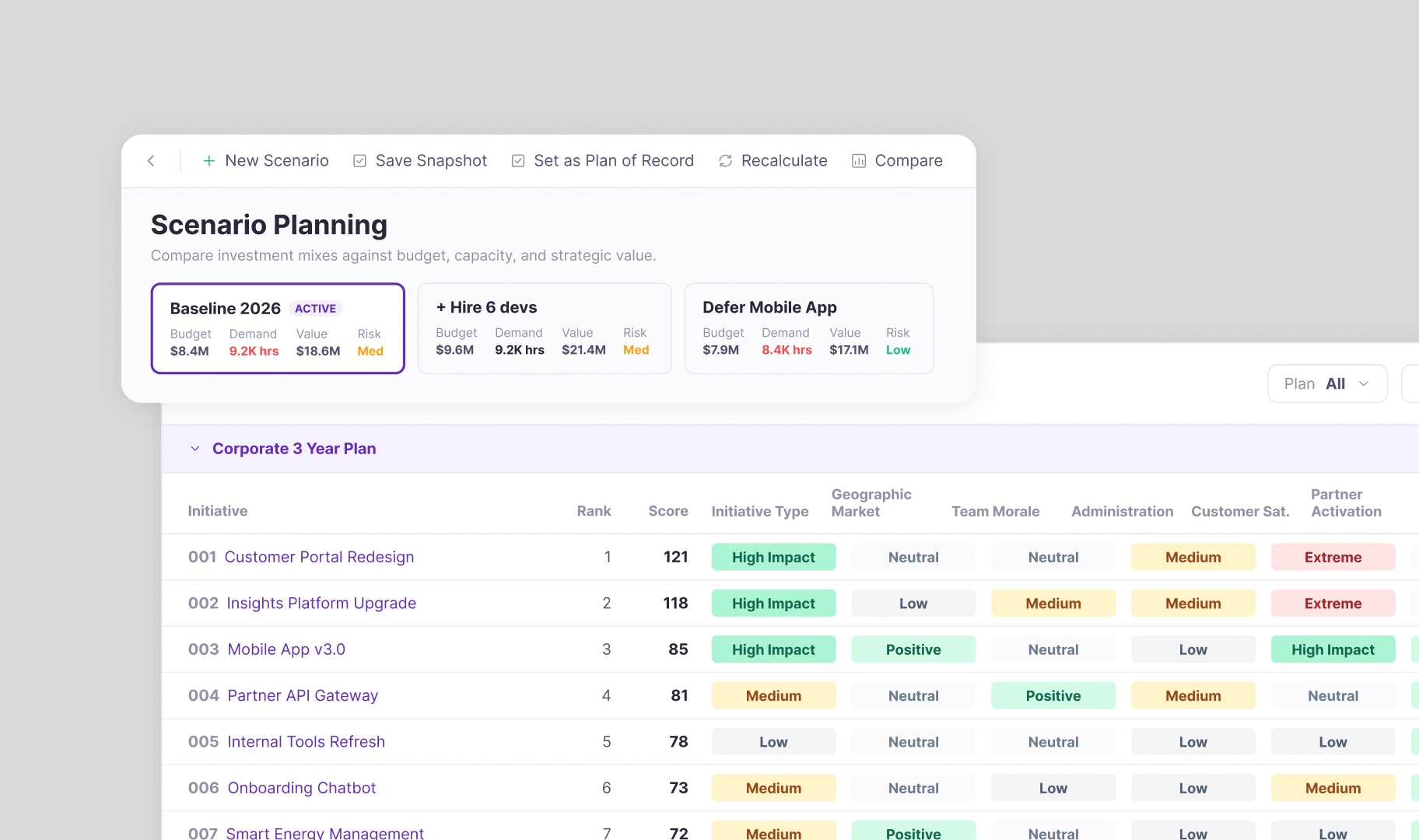
That capability doesn’t come from intuition. It comes from a trusted, current view of performance that connects strategy, investment, delivery, resourcing and benefits into one decision-making framework. When leaders can see how each initiative feeds strategic outcomes, weigh the trade-offs of every decision, and model the consequences before acting, they stop reacting to uncertainty and start managing it.
Which points to the biggest misconception about modern PPM. It isn’t there to eliminate uncertainty; no platform can. Its job is to reduce uncertainty where it can, expose it where it remains, and give leaders the confidence to act anyway. In an unpredictable world, that confidence is becoming one of the sharpest advantages an organisation can hold.
The bottom line
Every generation of leaders gets a defining challenge. This one is constant change. Economic conditions swing, geopolitical events reshape markets overnight, AI is rewriting whole industries, and strategic priorities shift faster than any annual planning cycle was built to handle.
In that environment, you can’t run a portfolio on disconnected information, stale reports or instinct. You need to continuously understand where you are, what’s changed, and what to do next.
That’s why modern PPM belongs alongside your financial systems, customer platforms and cybersecurity as a core capability, not a reporting afterthought. It gives you the visibility to align investment with strategy, the intelligence to weigh competing priorities, and the governance to keep resources on the work that matters most.
The organisations that thrive through uncertainty won’t necessarily have bigger budgets, more people or better forecasts. They’ll have something more valuable: the ability to make better decisions, more consistently, than their competitors. In the years ahead, that may prove to be the advantage that matters most.
Ready to unlock project success?
Schedule a demo to find out more about how Altus can help your organisation unlock project management success and reach your strategic goals.