

Why stakeholder management matters
Projects don’t fail solely because of bad technology or missed deadlines. They fail because the people who needed to be involved weren’t, the people who needed to trust the process didn’t, and because the people who needed to change their behaviour had no real reason to. That is a stakeholder management problem, and it is far more common than most organisations care to admit.
We spoke with four experts from project delivery, product management, and strategy. They don’t always see things the same way, and that’s the point. Stakeholder management looks different depending on your role, goals, and who you need to bring along. But they all agree on this: it matters more than most people think, and getting it right is one of the surest ways to improve results.
Meet the experts
- Piet Remen: Executive Director at Altus, leads enterprise Altus implementations across executive, PMO, and delivery teams. He’s seen what happens when the right people aren’t in the room and built the practice of making sure they are.
- Sara Gillard: Product Manager at Altus, brings an outcome-first discipline to engagement, focused on structuring communication so people can act rather than just absorb.
- John Price: Head of Customer Success at Altus, views stakeholder management as a hearts-and-minds campaign. His experience sits at the intersection of complex project leadership and customer outcomes.
- Li Si Wong: Senior Product Manager at Altus, drives global transformation, with a focus on trust, continuous alignment, and the stakeholders who go quiet rather than push back.
What is stakeholder management?
Stakeholders are any person, group, or organisation whose interests may be positively or negatively affected by the outcome or operations of a project or organisation. Stakeholder management involves organising, monitoring, and improving relationships with those people. Its core purpose is to build support, reduce risk, and enhance decision-making by aligning stakeholders’ expectations with project or organisational goals.
Ask four experienced practitioners to define it, though, and you get four distinctly different answers, all of them useful.
“It’s about making sure the right people are involved, consulted, informed, and supported, and a great deal of it relies on relationship management.”
— Piet Remen, Executive Director, Altus
“Running a project is a hearts-and-minds campaign. Stakeholder management is about ensuring there is only a single narrative and collective buy-in for the outcomes.”
— John Price, Head of Customer Success, Alus
“Aligning the right people to the right outcomes, at the right time, with enough context to make good decisions.”
— Sara Gillard, Product Manager, Altus
“The ongoing work of understanding who has a stake in your decisions, and making sure they stay informed, aligned, and engaged at the right moments, not just when something goes wrong. The key is continuous alignment and shared understanding that builds trust.”
— Li Si Wong, Senior Product Manager, Altus
Put simply, there’s no single way to define stakeholder management. It’s a mix of practices that shift depending on the project and the people involved.
Stakeholder management in project management
In projects, stakeholder management means figuring out who matters, planning how to keep them involved, and managing those relationships from start to finish. It keeps everyone on the same page, reduces surprise pushback, and helps decisions get made when they need to.
Without bringing the right people into the conversation at the right time, without noticing when people feel ignored, misunderstood, or sidelined, or when authority is unclear, and assumptions haven’t been stress-tested, resistance grows, decisions stall, and misalignment forms. Effective stakeholder management resolves all three.
As Piet explains from his experience implementing Altus across enterprise environments, different stakeholder groups carry fundamentally different priorities, and those priorities shape every interaction:
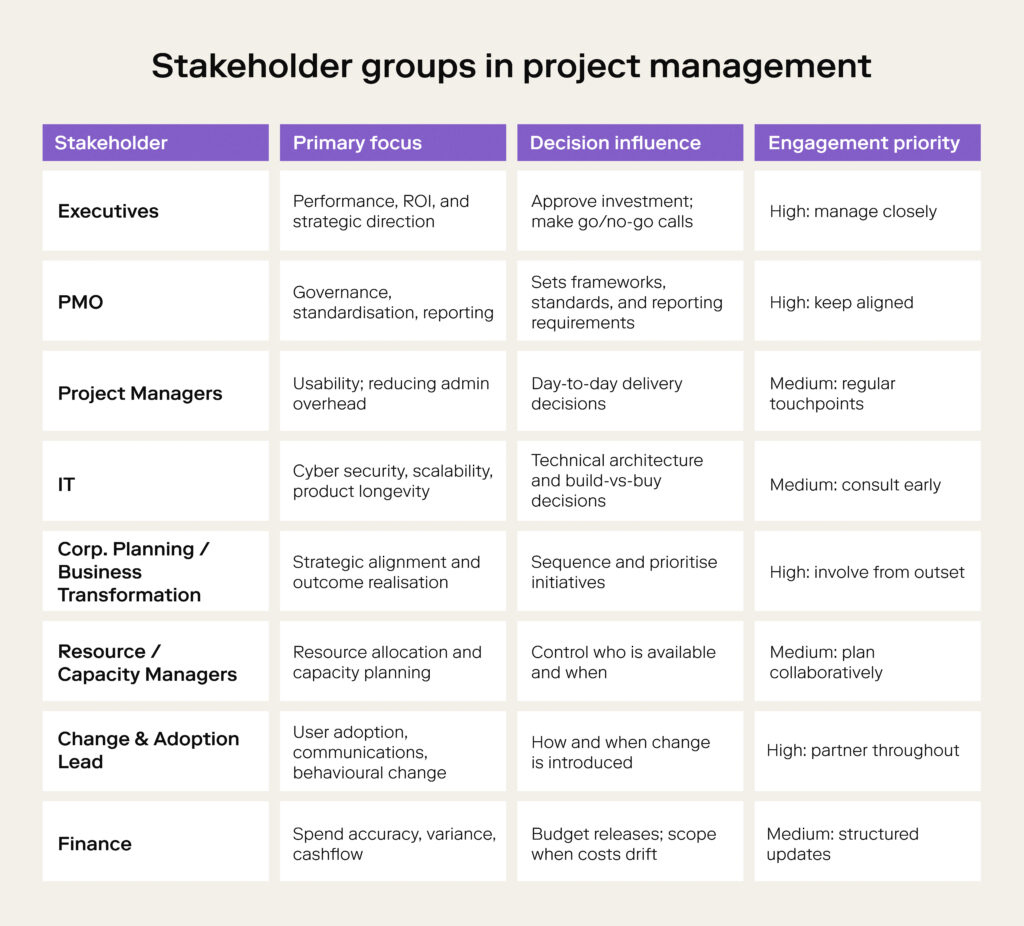
Balancing different stakeholder expectations
Stakeholder expectations represent what each group believes the project should deliver, whether that is a return on investment, a secure and scalable solution, a smoother workflow, or a measurable shift in behaviour. Because each stakeholder views the project through a different lens, their expectations will naturally vary and will sometimes conflict.
Balancing expectations doesn’t mean giving everyone what they want. It means making sure people feel heard, understand the trade-offs, and see how decisions were made. If you don’t manage expectations, the gap between what people expect and what actually happens grows, and that’s where frustration and conflict start.
Different expectations aren’t a problem to solve; they’re a reality to work with. Here’s a practical way to navigate them:
| Identify stakeholders | Establish who has an interest in or influence over the project. Understand their role, level of power, and what they stand to gain or lose. A power/interest grid is a useful tool here, helping to prioritise where engagement effort should be focused. |
| Understand expectations | Engage each stakeholder group to surface what they actually want, not just what they say, but the underlying need behind it. Executives wanting ‘visibility’ may really need confidence that risk is under control. Uncovering the real expectation is what makes engagement meaningful. |
| Assess and prioritise | Not all expectations can be fully met, and some will conflict. Assess which are essential to project success, which are desirable but flexible, and which may need to be reset. Being clear about this early prevents harder conversations later. |
| Align to scope and plan | Once priorities are understood, ensure the project plan, resource allocation, and governance structure genuinely reflect them. If an expectation cannot be met within current constraints, say so explicitly rather than letting it sit as an unspoken assumption. |
| Communicate consistently | Manage expectations continuously through structured, tailored communication. Different stakeholders need different information at different frequencies. Regular updates, milestone reporting, and honest escalation of issues all prevent the expectation gaps that lead to frustration and conflict. |
| Monitor, review, and adapt | Expectations shift as projects evolve. What satisfied a stakeholder at initiation may no longer hold at execution. Build in regular checkpoints to revisit expectations, address emerging concerns early, and adjust engagement approaches where needed. |
Why engagement matters: the cost of getting it wrong
The consequences of disengaged stakeholders
Disengagement doesn’t look like a big crisis. It creeps in quietly, missed signals, slower decisions, and issues that should have been sorted early now landing on leaders’ desks. By the time you notice, the damage is already done.
Li Si captures this dynamic with clarity: “Disengaged stakeholders don’t disappear; they become blockers, escalation risks, or silent saboteurs. Poor engagement doesn’t just damage one relationship; it erodes trust in the entire project and team.” The compounding nature of that erosion is what makes disengagement so costly. By the time it becomes visible, the recovery is significantly harder than it would have been to prevent it in the first place.
Li Si also points out something that often gets overlooked: early, consistent engagement surfaces issues while they are still cheap to fix. Waiting for resistance to surface publicly is waiting too long.
The link between engagement, adoption, and trust
All four experts agree: engagement is the foundation for adoption, trust, and real benefits. You can’t bolt those on at the end.
Piet has seen it repeatedly throughout his career: adoption fails if you don’t engage people early. Stakeholders who help shape a solution are the ones who use it, back it, and make it part of their work. If they only see it at go-live, it feels forced, and that’s when change doesn’t stick.
Trust works the same way. It builds slowly through honest, regular communication, and disappears fast if people feel left out or blindsided. Real benefits only show up when people change how they work, and engagement is what makes that happen.
Promoters, passives, and detractors
A practical way to understand the stakeholder landscape at any point in a project is to think in terms of three groups, drawn from the Net Promoter framework. John names them directly: “Promotors are those stakeholders who are invested in the outcomes and provide positive promotion of the project. Detractors are those working against the interests and outcomes of the project.”
What makes John’s framing valuable is what comes next. He notes that both groups require equal investment of time, but for very different reasons: “Promoters’ expectations need to be tempered to avoid them over-promising. Detractors need to be contained so they don’t damage the project’s brand.” It is important to understand that promoters are not a passive asset. They are an active variable that can work for or against you depending on how they are managed.
Don’t forget the ‘passives’, the people who show up but don’t really care. They’re often your biggest opportunity. If you can figure out what matters to them and connect the project to their interests, you can turn a passive into a real supporter.
Forecasting and managing issues before they occur
The most effective project managers treat stakeholder sentiment as a leading indicator, a signal of what is coming, not just a reflection of what has happened. By regularly mapping each stakeholder’s current level of engagement against the level required for delivery, gaps become visible early.
Changes in behaviour are early warnings worth tracking. Declining attendance at forums, shorter, less considered responses, and reduced quality of input. These often appear weeks before a problem escalates formally. Structured pulse surveys, conducted at key milestones rather than at the end of a project, provide a quantifiable view of where sentiment is shifting. One-on-one conversations ahead of governance forums offer a further layer of early intelligence, surfacing concerns in a lower-stakes setting before they become entrenched positions in a group context.
Principles of effective stakeholder management
Make engagement relevant and outcome-driven
Generic status reporting is one of the most common ways stakeholder engagement fails. A weekly update telling people that the project is “on track” gives stakeholders no reason to lean in, no decision to make, and no connection to why the project matters to them. Irrelevant information trains people to stop reading.
Sara has developed a model she applies consistently in her product management work, one that replaces the status report with something far more useful. She calls it the Outcome-first communication model:
Sara’s Outcome-First Communication Model
- Outcome: What are we trying to achieve?
- Why: Why does it matter, and what is driving the priority?
- Progress: What have we done toward it?
- Risk: What might prevent us from getting there?
Example: Outcome: Reduce time to value for POL migration | Why: Customer demand + commercial priority | Progress: Migration tooling + AfP uplift underway | Risk: Testing capacity
This structure positions stakeholders as participants in delivery rather than passive recipients of information. As Sara puts it, the goal is to involve stakeholders in decisions, not updates, and to show progress in terms of outcomes, not features.
Piet sums it up: stakeholders engage when they see value, and value means different things to different people. Executives want to see return and risk. Finance wants to know the money is well spent. Project managers want clear decisions and dependencies. ‘What’s in it for me?’ isn’t cynical; it’s how everyone processes information. Speak to that, and your engagement will land.
Building ownership through involvement
There’s a big difference between consulting stakeholders and actually involving them. Consultation means you ask for input, then move on. Involvement means you ask for a contribution and show how it shaped the outcome. That difference matters.
Piet notes that co-design builds ownership, and stakeholders who help shape a solution are far more invested in its success than those who are simply informed of it. This can be achieved through design workshops, validation checkpoints, show-and-tell sessions, and structured feedback loops where input is visibly acted upon.
Li Si adds a critical operational point: “The biggest engagement killer is the ‘black hole’ feeling, where stakeholders share input and never hear what happened to it. Even a brief ‘here’s what we did with your feedback’ response changes the dynamic.”
Piet puts it simply: don’t let feedback disappear. Acknowledge it and act where you can. It’s not enough to do something, you have to show you did it. Closing the loop is what builds trust.
Create rhythm, visibility, and engagement cadence
For all four experts, consistency matters more than frequency. Stakeholders do not need to hear from a project every day; they need to know when they will hear from it, what to expect, and that those touchpoints will be worth their time. Predictable rhythms, such as regular updates, milestone demos, and governance forums, create a sense of momentum and signal that the project is in control.
Quick wins matter. Early, visible progress, even on small things, shows the project is moving, and the investment is paying off. It keeps people interested when the bigger outcomes take longer to land.
However, cadence can become a problem in its own right. Over-engagement is a real risk that is frequently underestimated. Too many touchpoints, irrelevant updates, and meeting overload erode goodwill as surely as silence does. The signals are recognisable: declining attendance, shorter, less considered responses, and reduced quality of input. The instinct is often to add more communication. The better response is to audit the existing cadence honestly and remove what no longer serves a purpose. Sometimes reducing a touchpoint builds more trust than adding one.
Managing difficult or resistant stakeholders
Resistance is rarely irrational. Behind almost every resistant stakeholder is an unmet concern, a fear of losing control, uncertainty about what the change means for them personally, or a genuine belief that the project is heading in the wrong direction.
John is direct about this: detractors need to be contained so they don’t damage the project’s brand. That might sound harsh, but it reflects the reality of how resistance compounds when left unmanaged. The key is to engage it early, before it hardens.
It is also important to distinguish between vocal resistors and silent blockers. Vocal resistors have surfaced their concerns, which means there is something to work with. Silent blockers are more dangerous; they participate without committing, raise no objections in forums, and then fail to act or quietly undermine progress outside the room.
The best way to handle resistance is to engage early and one-on-one, before it goes public. Private conversations let you surface and address concerns before they harden in front of a group. Escalation should be a last resort; do it too soon, and you risk making things worse.
Frameworks for stakeholder management
Stakeholder mapping and the Power–Interest Matrix
Not every stakeholder needs the same attention. Treating them all the same wastes time and energy. The Power–Interest Matrix helps you focus by mapping who has influence and who cares most, so you can tailor your approach.
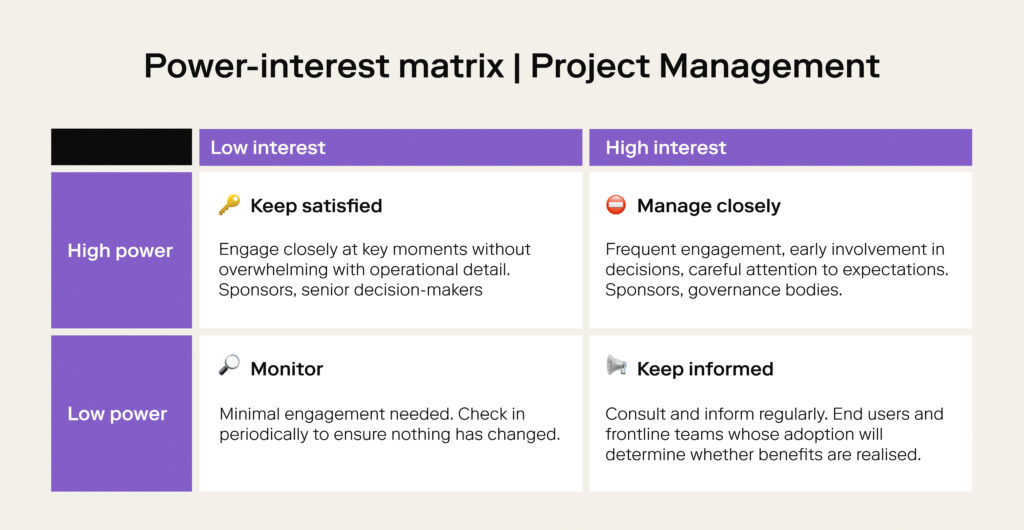
As both Li Si and Sara observe, power and interest determine engagement strategy, and one-size-fits-all engagement doesn’t work. Li Si frames the matrix as “the entry point”, not the complete answer, but the starting point for tailoring engagement. Sara uses it to decide who influences decisions and who needs context, keeping the approach lean and purposeful.
But the matrix isn’t enough on its own. It’s easy to miss the less obvious stakeholders, such as compliance teams, downstream users, partners, or anyone who inherits the project’s outputs. To find them, ask directly: ‘Who else is affected by this?’ and look beyond the usual org chart.
A structured lifecycle approach – PMBOK® and PRINCE2®
PMBOK®: A Guide to the Project Management Body of Knowledge by the Project Management Institute
PRINCE2®: Is a popular project management methodology. The term “PRINCE” refers to PRojects In Controlled Environments.
Both the PMBOK and PRINCE2 treat stakeholder management not as a continuous discipline but as one that spans the entire project lifecycle. This is a critical distinction. Stakeholder analysis conducted only at initiation quickly becomes a snapshot of a reality that has changed.
Li Si describes this four-stage sequence as “the backbone” of effective practice, and Piet adds that it is only effective when treated as ongoing rather than episodic:
The four-stage lifecycle (PMBOK® / PRINCE2®)
- Identify: Establish who has an interest in or influence over the project. Understand expectations and capture them in a stakeholder register.
- Plan: Determine how each stakeholder group will be engaged: frequency, channels, and purpose.
- Manage: Execute those plans through structured communication, involvement in decision-making, and active relationship management.
- Monitor: Regularly review whether engagement is working, whether stakeholder positions have shifted, and whether the plan needs to change.
One of the biggest challenges is stakeholder turnover. Sponsors change, teams restructure, and new people rarely have the context they need. Without proper onboarding, they often revisit old decisions, slowing things down. A simple onboarding process fixes this: give new stakeholders a quick history, show them the decision log, introduce them to the governance rhythm, and point them to the single source of truth. It speeds up onboarding, reduces disruption, and helps everyone add value faster.
Governance, decision clarity, and meeting cadence
Unclear decision rights cause more friction than most teams realise. If people don’t know who approves, who gets consulted, or who just needs to be informed, decisions get made in the wrong places, rehashed in later meetings, or escalated for no good reason.
A Decision RACI solves this. It maps out who’s responsible, who’s accountable, who gets consulted, and who just needs to know. Sara’s seen it: without clear decision ownership, you waste time and repeat conversations. A well-crafted RACI reduces rework and escalations by making everyone’s role clear from the start.
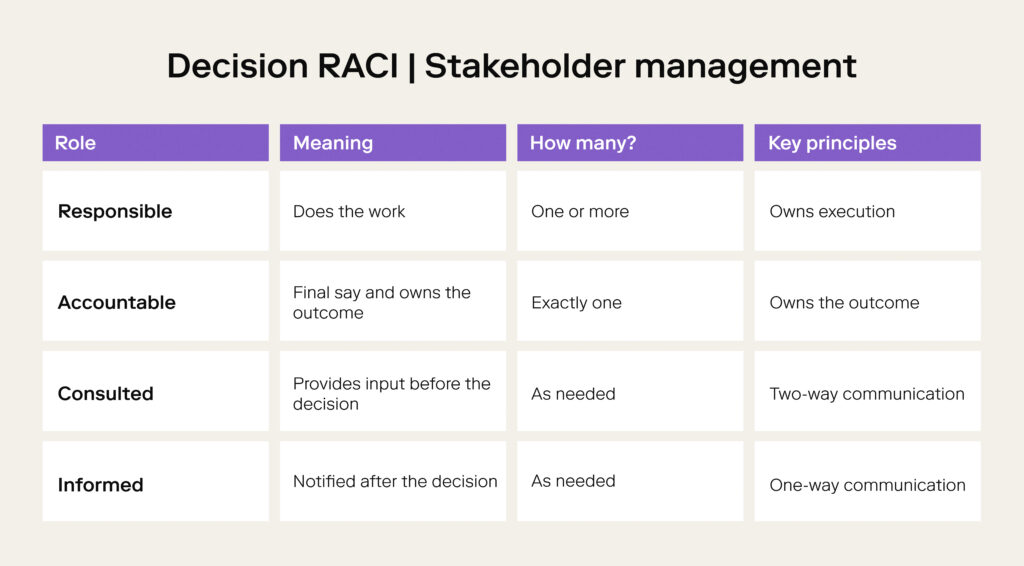
Structured meeting cadences complement the Decision RACI by creating the rhythm within which decisions are made, and accountability is maintained. One model Piet consistently uses, and that has proven particularly effective in steering committee environments, is the L10, or Level 10 Meeting, format developed by Gino Wickman as part of the Entrepreneurial Operating System (EOS).
An L10 is a weekly, fixed-format meeting that headlines, scorecards, holds accountability, and features a real issues list where problems get solved, not just parked. Piet likes it because it keeps meetings focused and stops the drift into endless status updates. When meetings become all talk and no action, people tune out. The L10 keeps things moving and ties strategy to weekly results.
How to measure stakeholder management success
Measuring the effectiveness of stakeholder management is not straightforward, because success looks different depending on who you ask. Piet is direct about this: each stakeholder group defines success through its own lens. Executives measure it in outcomes and return on investment. Project managers measure it in decisions made and obstacles removed. End users measure it by whether the solution actually works for them. A meaningful measurement approach has to account for all of these perspectives.
For Piet, success with Altus means executives make timely decisions using real insights, PMOs enforce governance, and project teams use the system in their daily work. These aren’t abstract, they’re what good looks like in practice.
Quantitative indicators
The most accessible measures of stakeholder management effectiveness are behavioural, what stakeholders are actually doing, not just what they say. Adoption rates are among the clearest signals. Low adoption rarely indicates a technical failure; it almost always points back to insufficient involvement, inadequate communication, or unresolved concerns that were never surfaced.
Governance participation is another telling indicator. Consistent attendance at forums, timely responses to consultation requests, and active contribution to decision-making all suggest that stakeholders see the process as worthwhile. Declining participation is an early warning that engagement has lost relevance.
Decision turnaround time is perhaps the most operationally significant measure. As Sara notes, faster decisions and fewer escalations are reliable signals that stakeholder engagement is working. When the right people are informed, aligned, and clear on their authority, decisions move quickly. Tracking the time from decision raised to decision made provides a concrete view of whether governance and engagement are functioning as intended.
Qualitative indicators
Numbers alone do not tell the full story. In Li Si’s experience, trust and advocacy matter as much as metrics, and neither can be captured in a spreadsheet. Trust is evident in the quality of conversations: whether stakeholders raise concerns early or only when things have gone wrong, whether they engage candidly in one-on-one discussions, and whether they are willing to publicly associate with the project.
The quality of feedback is equally revealing. Rich, considered, specific input suggests that stakeholders are engaged enough to have formed genuine views and confident enough to share them. Brief, non-committal responses suggest the opposite. And advocacy, the strongest qualitative signal of all, indicates that a stakeholder has moved from passive acceptance to active support. They are promoting the project in conversations the project team is not part of, which is the most durable form of endorsement available.
Leading versus lagging indicators
One of the most important distinctions in measuring stakeholder management is the difference between leading and lagging indicators. Lagging indicators, adoption rates, realised benefits, and project outcomes, tell you how engagement performed after the fact. They are valuable for reflection, but by the time they are visible, the opportunity to intervene has passed.
Leading indicators are the signals that precede outcomes: changes in meeting attendance, shifts in response quality, the emergence of new informal concerns, or movement in stakeholder sentiment scores. These measures allow a project team to act early, adjust the engagement approach, re-engage a drifting stakeholder, or address a concern before it hardens into resistance.
A simple stakeholder health tracker that maps engagement, decision speed, and sentiment will give you the visibility to manage proactively, not just react. It doesn’t need to be fancy. It just needs to be honest, consistent, and used to change course when things aren’t working.
Technology’s role in stakeholder management
Before talking about what technology can do, it’s worth saying what it can’t. No platform replaces real relationships, honest conversations, or the judgment needed to handle resistance and competing priorities. Technology helps, but it doesn’t do the job for you.
What technology does well is remove friction. It prevents updates from getting lost, keeps information out of buried email threads, and makes governance visible rather than hidden in documents no one reads. It helps keep stakeholders in the loop, even when everyone’s busy.
What good technology-enabled engagement looks like
Good technology makes stakeholder management visible, relevant, and easy to access. Everyone sees what matters to them, in a format that makes sense for their role. Decisions are traceable, progress is clear, and governance is part of the work, not an extra chore.
Sara frames this from a product management perspective: the goal is to make priorities visible and justified, to show progress in terms of outcomes rather than features, and to involve stakeholders in decisions rather than simply sending them updates. That framing applies equally to how a platform like Altus should be configured and used.
Piet describes what this looks like in practice. Altus provides a single source of truth, one place where project status, decisions, risks, and actions are maintained and accessible across the stakeholder landscape. When every stakeholder is looking at the same information, conversations shift from debating what is happening to deciding what to do about it.
Role-based views extend this further. Executives see portfolio performance and strategic risk. Project managers see delivery detail and decision queues. Governance bodies see what requires their input and when. Stakeholders are more likely to engage with information that speaks directly to their responsibilities than with a generic report they must interpret themselves.
Perhaps most significantly, embedding governance into day-to-day work closes the gap between where decisions are made and where they are recorded. Altus supports this by integrating with Microsoft 365, surfacing project updates in Teams, enabling collaboration around risks and issues, and reducing friction for stakeholders who can engage without stepping outside their existing environment. That reduction in friction is not a minor convenience. It is often the difference between a governance process that is followed and one that is quietly bypassed.
Remote and distributed stakeholder contexts
Geographic and time-zone distribution fundamentally changes the dynamics of stakeholder engagement. In a co-located environment, alignment happens informally as well as formally, in corridors, before meetings, and through the incidental conversations that keep people connected to a project’s progress. In a distributed environment, none of that happens by default. The only alignment that occurs is the deliberately designed one.
Adapting engagement for distributed contexts means shifting from reliance on synchronous meetings, which favour those in convenient time zones, toward asynchronous mechanisms that allow stakeholders to engage on their own schedule without losing access to the information they need. Recorded decision logs, shared dashboards, and structured written updates that stand alone without requiring a meeting to interpret them all reduce the dependency on everyone being available at the same moment.
Altus supports distributed engagement by reducing the reliance on synchronous interaction for alignment. When progress, decisions, and risks are always visible in a shared environment, stakeholders in different locations can stay informed, contribute asynchronously, and participate in governance without being present in real time.
What technology cannot replace
It is worth ending where we started. Each expert was asked, implicitly or directly, what technology cannot replace in stakeholder management. Their answers converge:
In their own words
Piet: Technology enables Altus to become an embedded platform, but it is the engagement, the trust-building, and the human relationships that make people want to use it.
Sara: Tools don’t make priorities clear. People do. Technology surfaces the information; judgment decides what matters.
John: No platform wins hearts and minds. That’s still a human job.
Li Si: Technology can surface the signals. Acting on them, having the conversation, closing the loop, rebuilding trust when it’s been lost, that’s still entirely human.